Lloret de Vistalegre, Things to do and see, hotels, market
Lloret de Vistalegre is located right in the heart of Mallorca, and in many ways represents the true soul of Mallorca. Out here in the country, only rural idyll reigns, far from mass tourism, large white hotels and hectic weekdays.
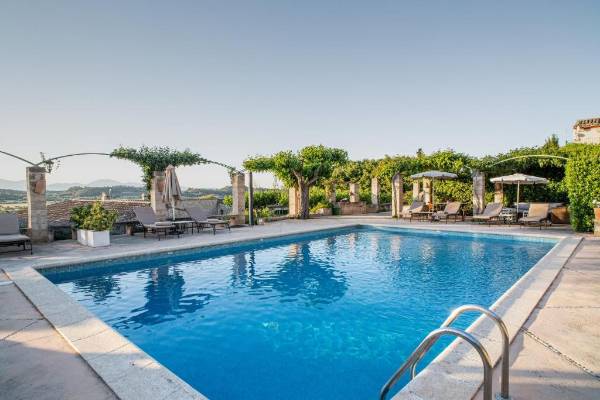
Lloret de Vistalegre is especially loved for the agroturismos located in the municipality, ie farms that also serve as accommodation. Here you can really relax in an authentic and deeply charming setting, while being pampered by local ingredients, beautiful views and spaciousness.
- This is where I want to go!
Why visit Lloret de Vistalegre
Things to do in Lloret de Vistalegre
Despite of its modest size, the municipality and village of Lloret has a lot to offer.
THE HEART OF LLORET, THE OLD DOMINICAN CONVENT
As the case with many Mallorcan villages, the churches and chapels plays or has played an important role in the forming of the local communities. This former convent was the reason that the village changed its name to the current. Today, you can find the town hall and the parish church in this place, absolutely worth visiting.
ENJOY A SCENIC WALK IN THE COMUNA
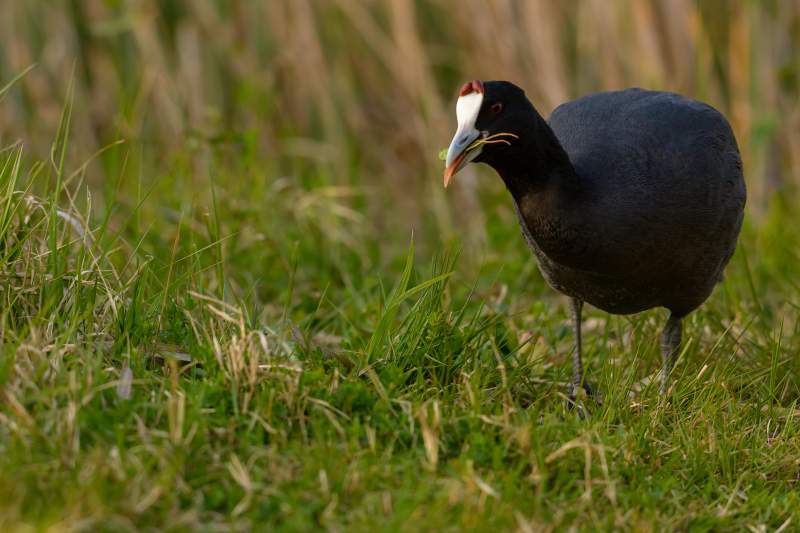
Just outside the village, you’ll find the wonderful nature park known as “Sa Comuna”, a public park full of Balearic wildlife to enjoy. Hares, rabbits, hedgehogs and various bird breeds are some of the animals you can meet in sa Comuna, as you stroll about between the pine trees, shrubberies and wild flowers. Sa Comuna covers a surface of 133 hectares of protected land, perfect for a nice walk. Inside the park, you will also discover a series of points of interest such as the first human inhabited caves from 1,700 BC, the old hunting cabins and the stone that marks real center of the island.
ESGLÉSIA DE MARE DE DÉU DE LORETO
The parish church of Lloret de Vistalegre rises in the very heart of the village. The church is named and dedicated to the worship of Our Lady of Loret, a tribute adopted by Franciscan monks in 1551 and built a denomination on. The church offers a lot of beautiful architecture and art treasures which are well preserved inside, among others. the remains of a Gothic altarpiece and coat of arms from monastic orders.
POU DE JURÀ
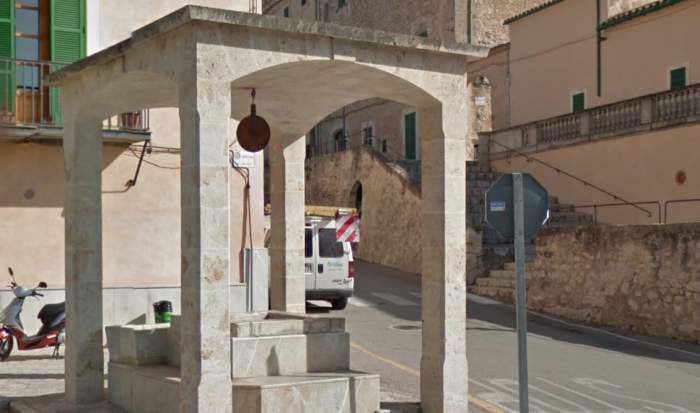
It is located in the old road to Inca, or Son Gelabert, next to the intersection with the Son Joan Arnau road north of Lloret itself. Its name is derived from the word: “jussà”, which means “inferior or lower”. The interior is an elliptic section with wall. The curbstone is a rectangular section with sandstone and solid stone, and the doorjambs are two sandstone pillars. On the side, there is a total of six basins which were formerly used as a water trough for animals.
ES POU

Although this well could very well be a leftover all the way back from Islamic times on Mallorca, this well is first documented in 1581. The well carries some beautiful reliefs carved into the cistern, displaying the Virgin of Loreto on one side and the crucified Christ on the other side.

DISCOVER THE OLD WINDMILLS
The mills are iconic landmarks of Mallorca, as well as important points of interest in Lloret which has a long history as an agrarian community. Especially the mills of Paleto and Beato are worth a visit.
Book your trip
All your holiday planning needs in one place, letting you book direct and benefit from official online rates
FAQ
Here are the best accommodation options in Lloret de Vistalegre:
- Agroturismo sa Rota d’ en Palerm
- Can Porretí Agroturisme
- Finca Can Blanc 018
Lloret de Vistalegre is located in the center of the island, approx. 33 km (~21 miles) from Palma airport. The transfer time by car or taxi is about 25 minutes.
A taxi from the airport will cost about 40-45 euros.
If you prefer a more comfortable transfer, consider an air-conditioned private minibus. Book here
The weekly market in Lloret de Vistalegre is held every Monday morning, starting around 8 am.
Events in Lloret de Vistalegre
Weekly market in Lloret de Vistalegre
The weekly market in Lloret is held on Mondays from 8 in the morning. This is a traditional farmers and crafts market full of products from the local area.
Annual events and happenings
May
May Fair
The May fair in Lloret de Vistalegre is a firm tradition in the village, which the inhabitants look forward to. The theme is agriculture, where tools, animals and agricultural products are in the forefront.
One of the highlights of the May fair in Lloret is that the eateries in the town come together to make special menus for the visitors. You can also experience performances of traditional Mallorcan folk dances, poetry readings and other cultural elements.
The May fair in Lloret is held on the second Sunday in May.
August
Festes de Sant Domingo
During the first week of August, Lloret de Vistalegre holds a town party, where you can experience a lot of cultural elements, among others. exhibitions, shows and competitions.
Support Local
Supporting local communities during your travels can have a profound impact. Stock up with groceries locally, stop in an artisan shop or enjoy a refreshment at a restaurant or bar. Now more than ever, these small businesses need support from travelers near and far.
Get to know the area of Lloret de Vistalegre
About Lloret de Vistalegre
Lloret de Vistalegre is a small agricultural area in the region known as “Pla de Mallorca”. The municipality comprises a population of about 1,500 inhabitants spread over a surface of 1,742 hectares. Lloret borders the municipalities of Montuiri, Sineu, Algaida, Sant Joan, Sencelles and Costitx.
History of Lloret
The first human occupation of the area goes back to the ancient Bronze Ages (1,700-1,110 BC), a period often times referred to as the Pre-Talayotic period on the Balearic islands. From that time, evidence of human activity has been found in the caves of Cova d’en Dainat as the best example.
The area continued to be occupied during the Talayotic culture (1,100-123 BC), from where remains of the village of Pleta de Son Gelabert d’Alt has been excavated.
The Islamic dominance of the island from 902 to 1229 introduced hydraulic engineering which allowed for building infrastructure to manage natural sources. The ability to transport and store water revolutionized the agriculture and horticulture on the island. It is most likely that the Moors got their water from the torrent of Llorac or Castellitx, built quanats to transport it, wells to capture it and tanks to store it in.
Practical Info
Useful Numbers
Emergency: 112
National police: 091
Local police: 092
Guarda civil: 062
Fire: 080
Maritime emergencies: 900 202 202
Town Hall: +34 971 524 189
Public Transport
Bus lines: 402
Power Supply
220V